Showing posts with label new authors. Show all posts

Tuesday, April 3, 2012

Recycle Those Old Manuscripts, Don't Trash Them!

I posted this status on Facebook last week:

New authors: Does you manuscript lack the 'fire' it needs to stand apart? Don't give up! Never trash those original ideas! Set them to the side and try again. You'll be surprised at how new ideas will begin to flow...you may even find yourself reaching for the original ms, pulling bits and pieces from it, and finding a way to make it shine! Old manuscripts are not necessarily bad ideas...just really well thought out musings!

Book 1-A Heart Not Easily Broken - completed: all notes and handwritten ms.
When I started writing three years ago, I thought my first manuscript was perfect. The characters were engaging, the dialogue witty and flowing... the story line engaging. Then I realized I didn't know what platform I wanted to use, much less what genre I was really in. All I knew is I had a story to tell. I wanted it to be a coming of age story but still be a romance. The characters were 18-21, so the story was more Young Adult. Because of the subject matter of the book, sex scenes were necessary, but I didn't want it to be labled as YA and didn't want to remove the love scenes  because they were pertinent to the story.  After listening to advice from my ever helpful critique partners, I decided to step away from the story and try something new.

Book 2- Jaded-editing: Original notes, scenes, new outline, 1st manuscript draft.
The next writing attempt followed  characters who were in their mid- to late twenty's, well established in their careers, and old enough to have as much sex as I felt comfortable writing about. The story line was completly different, and once again, I thought I had it nailed. Then I realized the characters were not real enough. I hadn't put in enough effort to make them believable. I didn't know their back story, didn't have a history to pull from to make my characters three-dimentional instead of two-dimentional. After sharing the first chapter with close confidants and having them nearly bored to death, I forced myself to listen to their honest feedback. They said, it was missing description in the scenes, and didn't grab their attention....I put that story aside as well.

Book 3 - Lonely Heart- wip:Notes from original ms and current rough outline.
After taking a writer's class, I found my writing platform. As a result, I pulled out the original manuscript, (thank god I didn't trash it like I started to!), focused on the heart of the story, and re-wrote it with older characters....after peeling back those 'onion' layers to discover who they were. As a result, I ended up with a much better story by 'resurrecting' bits and pieces of the original manuscript.

As I went through the previous manuscripts, I discovered various portions of the original stories can be recycled. I've enjoyed fitting the 'pieces' from the 'old' and and putting them together with the 'new'. I've been able to do this without pulling out the original pages to refresh my memory of the tale being told.
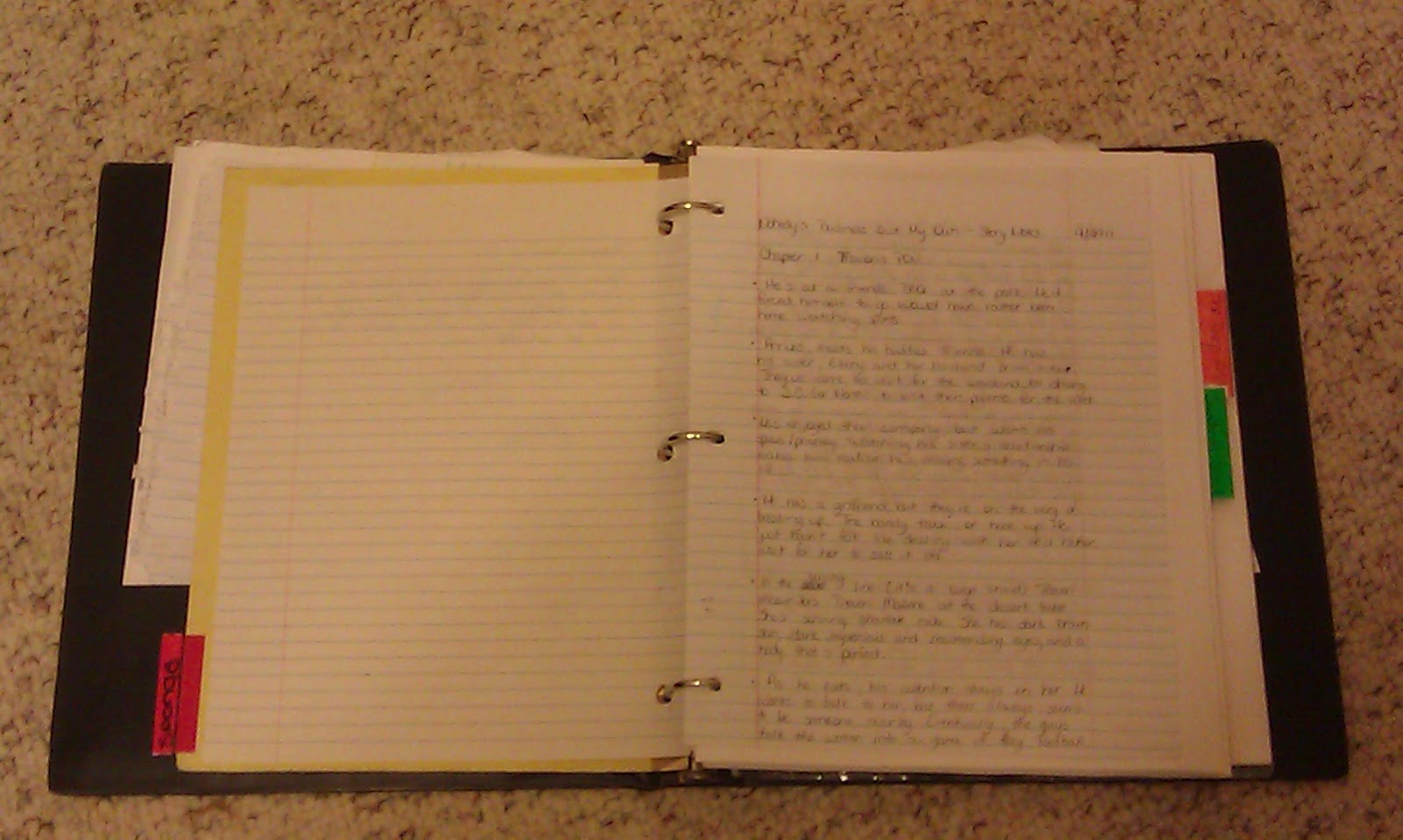
Book 4- Nobody's Business But My Own- planning:Notes, rough outline.
One thing I must point out: if you put down a manuscript and begin a complete re-write of the story, do it without reviewing your original work. Step away from the story for a few days, or weeks and let the old story line leave your thoughts. This is vital. Why? You don't want to end up writing the same stuff over again. As an author, the concept or idea should be imbedded on your mind without having to read it word-for-word. Doing so will allow the story to emerge from a fresh prespective. Switch up scenes, events, and add in more conflict, goals, and motivations. Before you know it, the story comes forth, and you discover certain events, dialoge, or even partial scenes connect to your original manuscript. You're original scenes can become back story to your current work.
Book #5-Untitled- planning: Outlines, notes, scenes. Book 6 is still buried deep in my head!

It's amazing how your creative mind can work!

One thing you must remember: Don't get impatient or discouraged! From what I've learned from my own writing journey, and all of the other authors I've had the opportunity to meet along the way, the average time it takes to write a good story is at least one year. It seems like a lot, but think about the steps it takes to write a story:
  • Create the basic plot. (goals, motivation, conflict)
  • Design the location, backdrop, or world for the story to take place.
  • Create the characters that will inhabit this world. (names, back story, goals, motivations)
  • Research jobs, topic for the story, etc., so the story can be as realistic as possible. 
  • Write a story outline. (rough draft/final draft)
  • Write first draft of manuscript.
  • Read first draft, then write second draft, and third, and fourth, as many as it takes to get it as good as possible.
  • Edit.
  • Read manuscript again.
  • Edit again.
  • Wait for your beta reader/critique partners to read and send back their thoughts.
  • Read/edit again.
  • Eventually get work professionally edited/proofread. 
  • And yep, edit again (I swear this step never seems to end!!!)
  • Eventually, when you look around, time has passed, and yep, a year has gone by! 
Now of course, everyone has their own way of doing things. Some are better, some are not. In the end, it's all about the amount of work willing to put into your masterpiece. Sometimes its a matter of trial and error. One thing I can be sure of, and I've gotten this from self-published, indie authors, and New York Times Best Sellers, you never stop learning or growing as a writer. With every book you write, your storytelling improves. I know mine has. Writing and editing my second book has not been near as hard as it was the first time. Why? Because I've learned a lot and have implemented the techniques. Don't get me wrong, it's still hard work, but the rewards of seeing the evolution of my work are priceless!

Remember, with hard work, creativity, imagination, perseverance, and patience, a lot of patience...you'll make that original story become great. Good luck!!

M.J.


Connect with me on the following sites: 

Facebook


Twitter


Google+


Linkedin


Tuesday, June 7, 2011

Finding the Correct Genre For Your Prose


 *The original post was done June, 7, 2011, but I felt the need to share it again. Since this post, things have changed. I have found an editor which I love dearly, and the series itself has changed from a three book series to a six book series, The Butterfly Memoirs. Also the ms title has changed from The Healing Heart to A Heart Not Easily Broken. It fits the theme of the story so much better. Please feel free to post your thoughts!*
  
This week I started edits for chapter three of The Healing Heart. This is going to sound weird, but after learning about the craft of writing, I've done what a lot of writers swear never to do: re-write my first story.

*Audible gasps of horror from hundreds of writes as I type*

"Why on earth would you re-write your first story?????"

Good question. I've read interviews and blogs of various authors - both published and non-published - who say they will never touch their first story again. Many felt their writing sucked, or because the story line wasn't strong enough. Most said it was due to rejection letters from publishers, or because their agent kept wanting to change what the story was about in order to fit their personal tastes.  That's something I refuse to do. Don't get me wrong, if an editor or agent had suggestions on what to change to make it a stronger sale, and I felt it would stay true to the story without taking the heart out of it, then yes, I would do it. Since I don't have an agent or an editor,  I'm relaying on my amazing critique partners to point me in the right direction. But change it completely? I don't think so. That's a decision I will make on my own.

And I did.

The reason why had nothing to do with fitting inside the neat little box of traditional romance stories. I am confident about the stories theme.  It originated as a form of personal therapy because of issues my family dealt with at the time. It was a way to keep my sanity without loosing it. My desire to write it and do it justice  inspired me to learn about writing. My determination and enthusiasm for this project has far outweighed my other creative form, floral design. I've studied the art of floral design for several year, it's a talent that I can do with my eyes closed. But now my love  of reading and storytelling has completely taken over. I feel so strongly about the story and the characters that what started out as therapy turned into a three book series.  All three books were written in a nine month period from start to finish, each a minimum of 350 pages.  And those were all typed without an outline. I'll never do that type of writing again.

Once I joined a critique group, I just knew I was well on my way to becoming a published author, whether by traditional means or self publishing.

Boy was I wrong.

The first and biggest thing I learned from my new critique partners when the began reading my story was this:  they had no idea what genre I was trying to be in.

'ROMANCE!', I replied.

I mean obviously. I said I wrote romance so I was, right?

Nope.

I was told my book came across as YA/Romance/Multicultural Romance/Chick Lit/Woman's Fiction. I needed to pick one in order to establish my genre.

My mind was completely blown. My writing spirit crushed. I didn't want to write YA because my story was going to contain adult romance themes. I wanted to write a maturation plot about an eighteen-year-old female who was learning life lessons about love, heartbreak, friendship, surviving tragedy and becoming a stronger woman because of it. But I needed to keep the theme of romance. And if this was YA, I would have to edit the love scenes down or out of the story because they're a key part of this young ladies road to discovering herself. Her emotional attachment to the hero and what devastates her in the key part of the plot. YA was definitely NOT what I wanted.


So, diving deeper into the many, many facets of the romance genre, I discovered Chick lit/Women's fiction.  I figured my story would definitely fit in here. But what grown woman would want to read about and eighteen-year old discovering her independence? (Okay, I admit, as a grown woman, I've been caught up in the Twilight Saga, have read all the books twice and own them all and can't wait for the last movie to come out, but that's definitely YA.)

SOOOOOOOOO.... what to do, what to do.

The first thing I did was put that story aside and went to work developing a whole new series. This one specifically for the Romance genre with Multicultural themes and adult h/h. It took a few months to write the story, but I struggled along. I fell in love with the h/h, brought the characters setting closer to home, but I still struggled on finding strong goals and conflict to catch the reader.

But then I did something that changed my writing career. I took a Writing Workshop.

Author Valarie Clark gave a workshop at the local Community Collage back in February. I had seen the advertisement for the class a year ago around the same time. But my budget wouldn't allow it. And I'm glad it didn't. I don't think I would have appreciated the significance of the class as much as I did this go round. One of the biggest things I learned from her was finding your writing platform, the over all theme that made my story stand out from the rest. And lets face it, there's a ton of wonderful, and not so wonderful, romance story's out there. Where could I possibly fit in?

And then it hit me. My first MS. The story that motivated me to begin writing. The Healing Heart.

I spent an evening FB chatting with one of my critique partners, discussing story themes, (remember that night Erin? lol)  All of a sudden, I've got it. Woman's Fiction/Romance with Multicultural characters.

Or at least that's what I think it is. LOL.... stay tuned for more updates!